Search California Death Records
 California Newspapers, Full Search (1846-2016), 459 titles
- California Obituary Search, (1865-current)
- California Birth Records Database, (1846-1899)
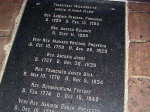 |
| Click photo to enlarge |
Mission Santa Barbara Cemetery
Santa Barbara, Santa Barbara County, California
Church Crypt
On the floor of the church altar, there are two plaques listing the names of persons found interred within the crypt. One plaque lists the names of Franciscan Missionaries, while the other lists the names of "lay persons". In 1911, the crypt was entered, and the remains identified. The information below was taken from the two plaques:
Alsina, Jose Maria, Rev., b. 01 Dec 1834, d. 28 Aug 1863
Bannon, Buenaventura, Rev., b. 27 Mar 1846, d. 06 Oct 1876
Beherle, Maxim, O.F.M., d. 09 Jun 1887
Cobernador De Cal, Jose Figueroa, Don, b. 1782, d. 29 Sep 1835
De Jose De La Guerra, Maria Antonia Carrillo, Dona, b. 08 Jan 1786, d. 26 Dec 1843
De La Guerra De Robinson, Maria, Dona, b. Nov 1821, d. 22 Nov 1854
De La Guerra Y Noriega, Jose Antonio, Don, b. 06 Mar 1779, d. 11 Feb 1858, "Capit. Y Comote Del Presidio Y Sindico De Los Padres"
De La Guerra, Pablo Andres A., Don, b. 29 Nov 1818, d. 05 Feb 1874
Dulanto, Andres, Rev., d. 11 Sep 1808
Duran, Narciso, Rev. Prefecto, b. 16 Dec 1776, d. 01 Jun 1846
Fortuny, Buenaventura, Rev., b. Feb 1774, d. 16 Dec 1840
Fundador, Antonio Paterna, Rev., b. 1723, d. 13 Feb 1793
Jaime, Antonio, Rev., b. 1757, d. 30 Nov 1829
Jimeno, Joaquin, Rev. Prefecto, b. 30 Nov 1804, d. 14 Mar 1856
Menendez, Antonio, Rev., b. 1785, d. 23 Apr 1832
Noriega, Antonio, d. Dec 1876
Payeras, Mariano, Rev. Prefecto, b. 10 Oct 1759, d. 28 Apr 1823
Uria, Francisco Javier, Rev., b. 10 May 1770, d. 05 Nov 1834In the cemetery, there is another plaque that provides additional information about the crypt. That information was copied and reproduced below:
Burials in the Church
Burials in the church after the very early period were restricted to priests and outstanding laymen associated with them. The first Fransican to die in Santa Barbara was Fray Antonio Paterna. A native of Palma, near Seville, Spain, he came to America in 1749. After missionizing for twenty years in the Sierra Gorda of Mexico, he came the California where labored successively at Missions San Diego, San Gabriel, San Luis Obispo and Santa Barbara beginning is ministrations at the latter place in 1786. He died on Febr. 13, 1793.
The second missionary to die here was Fray Andrés Dulanto who was buried on Sept. 12, 1808. He was from the Province of Cantabria and had served at Mission San Juan Bautista. He came to Santa Barbara to recuperate from illness. The remains of Paterna and Dulanto were placed in the new crypt of the final church, the one standing today, in 1820.
Succeeding burials, save on, took place in the new crypt. This crypt was built beneath the sanctuary, entrance to which is gained by a stone staircase from the sanctuary railing.
Governor Figueroa
The first layman to be buried in the same crypt was Governor José Figueroa, the first Mexican born governor of California, from 1833 until 1835. He died at Monterey, Sept. 29, 1835. Brought to Santa Barbara on the Avon, his remains were buried by Fr. Narciso Durán. Engelhardt identified his remains on Aug. 11, 1911. He attests that the remains were those of short-statured man enveloped in a bright uniform whose shoulder straps appeared to be of silver. A chapeau lay across the center of the remains. A sword was found on the left, which had rusted to within about eight inches of the hilt. On the right law a gold-headed cane which the governor had been known to use.
Crypt Examined and Remains Identified
In 1911 the crypt was opened and renovated. On this occasion all possible identifications were made and any changes in the arrangements of burials noted and a diagram drawn. The order of burials as they remain today in the crypt is as follows:
Vault 1:
- Captain José de la Guerra y Noriega (1858)
- Do�a Maria Antonia Carrillo de la Guerra, his wife (1843).
These remains were found in this vault and retained there. The captain's coffin was well preserved with his name on it. The remains of his wife, found in a box in the same vault, were placed in a new box and deposited in the coffin of the captain.Vault 2:
- Don Pablo de la Guerra, son of José (1874). The remains were found in a metal coffin and the face of the deceased could be seen through a glass at the head of the coffin.
- Do�a Anita Maria de la Guerra de Robinson, daughter of José de la Guerra (1854). She was identified by means of the initials "A.M.G." found next to the metal coffin of Pablo. She had originally been buried in the cemetery. The date of her transfer to the valut is not known.
Vault 3:
- The remains of Fr. Antonio Menéndez, O.P. (1832)
Vault 4:
- The remains of Fr. Buenaventura Bannon (1876) were placed in a new box of cedarwood and placed on the floor of the vault. A larger redwood box divided into four partitions numbered 1, 2, 3, 4, was placed on top which contained the remains of the following:
1. "Ex-ossibus" of Fr. Mariano Payeras who died at Purísima mission in 1823. These ossa had been found in vault 6.
2. Fr. José Alsina. His remains had been found in vault 6.
3. A skull and some bones found in vault 4. These could not be identified.
4. Five skulls and other bones. These had been found in vault 5 in the coffin of Gov. Figueroa on top of his remains and were judged to have been placed there when other vaults had to be emptied for future burials. According to Arentz, these remains, with on or two exceptions, were those from among the early friars buried there:
Paterna (1793), Dulanto (1808), Jayme (1829), Uría (1834), Fortuni (1840), Durán (1846), José J. Jimeno (1856).
The number of Franciscans buried in the crypt was ten.Vault 5:
- The remains of Gov. Figueroa. They were left in the vault in which they were found.
Vault 6:
- Max Berherle (1887). Originally he had been placed in vault 4. Other boxes found in vault 3 were also placed in vault 6. Arentz states that these were probably those Antonio Noriega of San Francisco who with his brother studied at the Boys' College at Mission Santa Barbara (1868-1877) and who died in 1876.
Browse More Cemetery Records