Search Death Records (United States)
 U.S. Newspapers, 50 State Full Search (1690-present)
- U.S. Obituary Database Search, (1696-present)
- U.S. Birth Announcements Database, (1700s-present)
 The
History of Veterans Day
The
History of Veterans Day
By Steve Paul Johnson, November 9, 2000
It was known as "the War to end all Wars". The first world war is considered today as the event which has had the greatest social and political impact in the annals of human history. It has been estimated that more than 61.5 million soldiers from all nations took part in the war, of which 8.5 million were killed, 12.5 million received recoverable injuries, and 7 million were permanently injured.
The United States, which entered the war late, suffered among the fewest losses, at approximately 116,000. Nevertheless, the impact the war had upon Americans was great. President Wilson, who boasted that he would keep the United States out of the war, shocked the country with his request for war.
November 11, 1918 marked the official end of the war. One year later, President Wilson proclaimed November 11, 1919, as "Armistice Day". It was the first nationwide commemoration of the war.
On November 11, 1920, England laid to rest an unknown soldier in Westminster Abbey, a way to commemorate their losses in the war. France had carried a similar act the same year at the Arc de Triomphe.
On November 11, 1921, the United States followed-up with their own version. An unknown soldier, who had already been laid to rest at a cemetery in Europe, was selected and placed aboard a ship to Washington D.C. It was to fill the new "Tomb of the Unknown Soldier". It was a much hyped and heralded event that received press coverage from coast-to-coast. Thousands of people flocked to see the body laying in state in the Capitol rotunda. There was a funeral procession down Pennsylvania Avenue. Each state sent in floral arrangements to adorn the tomb. President Harding laid a wreath of flowers on the casket. Taps was played. The casket was placed into the tomb at 11:00am. The President requested that all flags be flown at half-mast.
Though this event had been performed a year earlier in England and France, it had a more powerful effect among Americans. That single unknown soldier not only symbolized America's losses, but each American's losses and sacrifices in the war.
In the years following, 27 states had responded to that emotional event by adopting laws declaring November 11 as a legal holiday. The United States Congress reacted by enacting a resolution on June 4, 1926, asking the President to issue a proclaimation to display the nation's colors on all buildings on November 11. The resolution officially named the day, "Armistice Day".
On May 13, 1938, Congress enacted a new law that made Armistice Day a national holiday.
In 1947, just 2 years after the end of World War II, Raymond Weeks, organized a "Veterans Day" parade in Birmingham, AL, to celebrate all of America's veterans. In 1954, Kansas Representative Edwin K. Rees introduced a bill that would change the purpose of Armistice Day to honor veterans of all wars. On June 1, 1954, President Eisenhower signed the bill into law, officially renaming Armistice Day to Veterans Day.
Later that same year, on October 8, Eisenhower issued a proclaimation creating a new "Veterans Day National Committee" and naming the Administrator of the Department of Veterans Affairs as its coordinator. The Committee would be responsible for planning all national ceremonies and to set an example for state and local governments, as well as providing suggestions for Americans on how to celebrate Veterans Day.
On Memorial Day of 1958, two more unknown soldiers were reinterred along side the unknown soldier of World War I. One was a casualty of World War II and the other one of the Korean War. In 1973, a law was passed to add another unknown soldier from the Vietnam war, but none could be found until 1984.
In 1968, a law was passed to change the date of Veterans Day to the fourth Monday in October. This was done to give Americans a three-day weekend, thus affording them time to visit cemeteries, engage in ceremonies, and visit veterans memorials. But other Americans felt that November 11 was too much of an important day to forget. Many states continued to observe November 11. In 1978, President Ford signed into law a bill that would restore November 11 as Veterans Day.
Today, the Veterans Day National Committee coordinates all federal ceremonies relating to Veterans Day. Every November 11, a ceremony is held in Arlington National Cemetery, at the "Tomb of the Unknown Soldier". The President recreates the original event by placing a wreath at the tomb, and Taps is played. The Committee coordinates similar ceremonies at "regional sites" across the country.
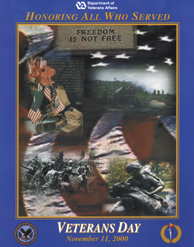
The Committee also prepares a school kit describing how schools should celebrate Veterans Day. Since 1978, the Committee has been hosting a poster contest, whereby highschool students are encouraged to create a poster commemorating Veterans Day. One winning poster from each state is selected, and from that group, one is selected as the national winner. The graphic at the top of this page is the 2000 national winner.
- Steve Paul Johnson
Sources for this article came from various documents published by the U.S. Department of Veterans Affairs, and from texts of actual laws and resolutions.
For Further Reading