Search Death Records (United States)
 U.S. Newspapers, 50 State Full Search (1690-present)
- U.S. Obituary Database Search, (1696-present)
- U.S. Birth Announcements Database, (1700s-present)
The International Cemetery of Tomari
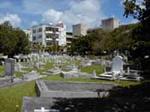 |
| The older part of the cemetery. Click to enlarge |
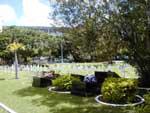 |
| View of the recent grave markers. Click to enlarge. |
by Paul E. Truesdell Jr., August 1, 1999
Paul E. Truesdell Jr. tells the history of this fascinating and historic cemetery, and his efforts to publish its records to the Internet.
The International Cemetery is located on approximately one-fourth acre of land between a "Family Mart" convenience store, a middle school, and the always busy Tomari Port in Naha City, Okinawa, Japan. It is strangely peaceful at the cemetery; the heavy traffic and hustle-bustle of the port goes unnoticed as you walk among the white crosses and, in the older part of the cemetery, the weather-worn head stones and memorials.
My never-ending interests in Okinawan history and in genealogy naturally made me curious about this small patch of land set aside as a final resting place for foreigners. This on an island where buildable land has always been at a premium. Discovery of the Internet and its millions of genealogy enthusiasts sparked my curiosity. Why not publish the surnames buried at this cemetery and make them available to all of those millions of researchers on the "net"? So began a crusade in March 1998.
While the vast majority of burials have occurred from 1955 to present day, the ravages of sea salt, typhoons, and seasonal rains have made over eighty percent of the pre-1985 grave markers and head stones illegible. This required locating written burial records in order to accomplish what I had started out to do. Several telephone call inquiries to various U. S. military and Japanese government agencies revealed that the Cultural Assets Branch of the Japanese Ministry of Education was responsible for the maintenance and upkeep of the cemetery. A simple phone call, I thought, would allow me access to whatever records they had. Now, almost a year and one-half later, after dozens of telephone conversations (my daughter acted as interpreter) and several visits to the Ministry, I finally was allowed to check out a copy of the burial records which had been maintained until the reversion of Okinawa back to Japan in 1985. Yes, perseverance (hounding) paid off; and my crusade has finally come to an end.
Twenty-two foreigners (six Chinese, eleven Americans, two Englishmen, one Frenchman, one Swede and one unidentified) were originally buried here, including a member of Commodore Perry's crew named "Board", who was beaten to death by local citizens after committing a rape. Several of the Americans were also from Perry's fleet. They came to Okinawa for trade and/or propagation during the 19th century.
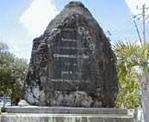 |
| Commodore Perry Memorial, English side. Click to enlarge. |
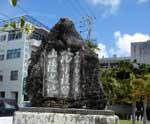 |
| Commodore Perry Memorial, Japanese side. Click to enlarge. |
Perry, Ambassador to the United States, was sent to Japan in 1853 for the opening of Japan to the world. He first landed on Okinawa at Tomari Port, ahead of his landing at Uraga on mainland Japan. Perry revisited Tomari Port a total of five times to use it as a supply base for his duties. In 1854, Perry signed a Treaty of Peace and Amity with Japan, then soon after signed a similar treaty with Okinawa. A memorial was erected in a corner of the cemetery in Commodore Perry's honor in 1964 by the Committee for the Restoration of Tomari for his hard work and dedication to bring Americans and Okinawans together. The memorial reads:
This monument erected in honor of Commodore Perry who, on June 6, 1853, landed near this place.
Immediately below the inscription on the monumental stone:
"Prosperity to the [*]LEW CHEWANS And May They and the Americans Always be Friendly" (Commodore Perry at a reception in his honor at OMIUDUN (The Royal Guest House) Shuri, Okinawa, June 6, 1853).
[*]Old term for Ryukyuans (Ryukyu Islanders)
Three graves predate the coming of Commodore Perry: Wm. Hares, d. 1815, "Englishman"; J. T. Doss, b. 1818, d. 1843; and Mathieu Adney, d. July 01, 1848 (A Missionary). There are also four very large, crypt-like markers reading simply "American". Subsequent to the twenty-two foreigners mentioned above, there have been approximately 300 burials, the latest in June 1999. A large percentage of the burials are those of infants whose interment was authorized during American control of the island. Unfortunately, it must be assumed in many of these cases that the military parents of these infants left their buried behind when transferred back to the United States.
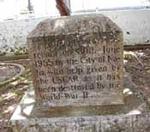 |
| The memorial commemorating the restoration of 1955. Click to enlarge. |
The cemetery had been almost destroyed during the battle for Okinawa during World War II. In 1955, a group of interested Okinawans and members of the U.S. military under the auspices of USCAR (U.S. Civil Administration, Ryukyus) began restoration of the cemetery. These individuals cleared the area of brush, repaired and re-erected headstones and grave markers, and officially designated the area as an international cemetery.
While Okinawa was under the control of the United States, the Okinawan Ministry of Education, Cultural Assets Branch, maintained burial records. Surname records were discontinued and statistical records begun when Okinawa reverted to Japan in 1985. The period between 1985 and today requires transcription of names from headstones. This is impossible in some cases as, even in the fourteen years between 1985 and 1999, the stones have become weatherworn and unreadable. According to the Ministry of Education, only about seven spaces remain for the interment of cremated remains. Once those spaces are occupied, the cemetery will be closed. There is a proposal being sent to the Japanese Diet to declare the cemetery a cultural and historical asset; thus protecting it from further development. There is also a "grass roots" movement to locate another site for use as a foreign cemetery.
As said previously, my crusade has come to an end and the names
of those individuals interred at the International Cemetery have
been published on the Internet. If only one genealogist locates
a "missing" member of his or her family line, all of the
telephone conversations and trips to Naha City will have been completely
worthwhile. If not...well, at least I accomplished what I set out
to do back in March 1998. 
- Paul E. Truesdell, Jr. [petjr@nirai.ne.jp]
August 1999
Okinawa, JapanRetired from the U.S. Navy, Paul lives in Okinawa with his wife, children and grandchildren, and is employed as a photographer for the U.S. Marine Corps. He has a BA in English and Asian Studies from the University of Maryland, Far Eastern Division. Often spends his time on genealogy, fishing, photography, and studying Okinawan history and culture.
Editor's note: to view the names of those interred at the International Cemetery visit...
https://www.interment.net/data/japan/international_cemetery.htmUpdate (April 17, 2000)! Mr. Truesdell has submitted a follow-up article detailing the efforts of the local VFW to clean up and maintain the cemetery. See, "Helping the Living by Caring for the Dead".