Search Michigan Death Records
 Michigan Newspapers, Full Search (1817-2018), 293 titles
- Michigan Obituary Search, (1869-current)
- Michigan Birth Records Database, (1817-1999)
 History
of Union Cemetery
History
of Union Cemetery
Wayne County, Michigan
Early Quakers from New England who began to fall away from the church of the Quakers brought about the formation of an non-denominational church. This church was known as the Union Society of Livonia. Located on the north side of Six Mile near Haggerty Road. Land was donated by Pardon Briggs (east) and another farmer named Stanton (west.) This consisted of one acre of land between the two farms. Pardon Briggs purchased his land on Dec. 2, 1829 and the oldest gravestone is that of Emery Sands, dated April 8, 1832. It is therefore assumed that the land was donated around 1830.
In 1856, the bylaws of the church were changed to read, "that no one be entitled to a share in the Burying Ground belonging to the Union Society of Livonia except those who have a share or shall take a share in stock of said corporation."
Many different denominations worshiped here including Methodists, Baptists and Universalists. In the 1930's the church with declining membership and lack of funds boarded up the building. In 1957 the Bethel Missionary Baptist Church was given the right to use the building with the understanding that they would repair and remodel it and maintain the cemetery grounds. After a few years the ownership changed to the Immanuel Baptists, followed by the Trinity Baptists -- who are the present occupants. For many years regular services where conducted here.
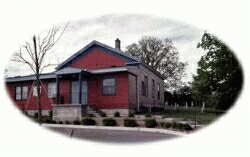
Currently the building houses the Trinity Community Theatre. The church gets a small financial assistance from the City of Livonia to help with upkeep of the cemetery grounds. The old fence is long gone, replaced on the West and North by a parking lot and newly constructed fencing. On the East lilacs and overgrown shrubbery create a natural fence line between the cemetery and a Pre-School. To the South it is bounded by the Trinity Theatre building and has a open property line.
The grounds have patches of wild overgrowth currently covering many of the stones. Toward the back there are wild areas with debris that may house some more stones or broken pieces. Some upright stones have broken in half and are either leaned up against something or scattered on the ground. Many older, possibly marble, stones have weathered to the point of being unreadable. Unknown to the visitor is how many markers have totally been lost. (I am not sure of the where about's of any cemetery records.)
- submitted by Julie Witkowski
Browse More Cemetery Records